The rise of forms of ‘Christian Nationalism’ in the UK raises a number of significant questions and concerns. On this page we have curated a number of articles and resources to encourage careful listening, theological reflection, and gracious engagement with this issue.
‘Christian Nationalism’ is a worldview which brings together religious and national identities, and promotes the political idea of ‘a Christian country’. Long a strand in American politics, it is of increasing significance in the UK context, though it takes various forms, and even the term itself is contested.
Particular concern was prompted when in September 2025, far right activist Tommy Robinson (real name Stephen Yaxley-Lennon) organised the ‘Unite the Kingdom’ rally in central London. This featured Christian prayer and the use of Christian symbols alongside speeches expressing hostility to refugees and immigrants, using Islamophobic rhetoric, and promulgating the ‘Great Replacement’ conspiracy theory, which stokes fear that ‘other’ religions and races are seeking to overwhelm ethnic white cultures, and that ‘we’ must therefore – in the words of Elon Musk speaking at the rally – “either fight back or die”.
Mainstream Christian leaders united to condemn this co-option of the Christian faith to exclude others, and a range of initiatives were coordinated in response to the prospect of the same organisers holding a Christmas event in Whitehall in December 2025. However, not all forms of Christian Nationalism involve such crude appropriation of Christianity to serve an extreme far-right political agenda.
The wider rise of Christian Nationalist ideas and movements raises a range of important questions: about the role of religion in politics; the relationships between people’s identities as Christians and as citizens of a particular country or members of a particular ethnic group; what Christianity has to say about other religions, the social order, the nation state, and contemporary policy challenges; what terms like ‘Christian culture’ and ‘Judeo-Christian heritage’ mean; how power, money and social media are influencing politics and public life; how churches might respond pastorally, prophetically and missionally to these trends; and many others.
The articles and resources that follow offer an overview of Christian Nationalism from a variety of perspectives, and seek to encourage careful listening, theological reflection, and gracious engagement. This is a growing collection, intended to help individuals and churches to understand and navigate these questions with wisdom, humility, and faithfulness to Christ. Inclusion in this list does not imply endorsement of the views expressed, but we do hope they will be helpful to individuals and churches seeking to better understand and respond to this phenomenon. If you are aware of helpful resources or perspectives that would strengthen this space, we welcome your suggestions.
Articles
Books
Podcasts
Resources
- The Baptist Union of Great Britain : Misuse of cross at Unite the Kingdom rally condemned by church leaders – Baptist Times, 25/09/2025
- This statement responded to the public use of Christian symbols at a political rally, expressing deep concern about the appropriation of the cross for nationalist purposes. It reaffirms that the cross stands for sacrificial love, humility, and reconciliation – not exclusion or political ideology – and invites churches to reflect carefully on how Christian faith is represented in public life.
- Challenging the Rise of the Far Right – The Methodist Church, 16/09/25
- In this article, Revd Jonathan Hustler, Secretary of the Methodist Conference, unpacks how the forms of Christian Nationalism on display at the Unite the Kingdom rally are motivated by a set of values which are diametrically opposite to the Methodist Church’s values as an inclusive and justice-seeking church.
- God’s kingdom, but whose tools? – Centre for the Study of Bible and Violence, Revd Dr Helen Paynter, 19/09/25
- This article offers a reflection on the ‘Unite the Kingdom’ rally. It probes the tension between Christian ends and political means, asking whether the pursuit of God’s kingdom can ever justify coercive or exclusionary tools. It challenges churches to consider how power, rhetoric, and strategy shape their witness in a contested public sphere.
- How Do We Respond to Christian Nationalism? – Centre for the Study of Bible and Violence, Prof John Heathershaw, 03/10/25
- This article explores Christian nationalism as a theological and pastoral challenge, examining how faith becomes distorted when fused with national identity and power. It offers churches a framework for faithful response rooted in scripture, discipleship, and peace-making, encouraging thoughtful engagement rather than reactive polarisation.
- Transcending Christian Nationalism – Centre for the Study of Bible and Violence, Prof John Heathershaw, 24/10/25
- Building on earlier reflections, this piece calls Christians to move beyond reactive critiques toward a more constructive, Christ-centred imagination. It challenges churches to resist fear-based narratives and to embody a kingdom vision shaped by justice, humility, and hospitality.
- The Book of Revel-hate-ions: How Christianity is being co-opted by the far right – HOPE Not Hate, Right Response Team, 25/09/25
- This report explores how far-right movements selectively draw on Christian language, symbols, and apocalyptic themes to legitimise exclusionary and nationalist politics. Produced by HOPE not hate – a well-established secular UK organisation that researches and challenges far-right extremism – the analysis offers a valuable external perspective on how Christianity is being perceived, used, and sometimes distorted in the public square, helping churches to see patterns and risks that can be less visible from within Christian communities themselves.
- Christian nationalism in the UK: a contest for the nation’s soul? – The Evangelical Alliance, Peter Lynas, 23/09/25
- This article offers an evangelical perspective on the emergence of Christian nationalism in the UK, distinguishing historic Christian influence from modern nationalist distortions. It invites Christians to reflect on where ultimate allegiance lies and how faith can be expressed publicly without being co-opted by extremist political agendas.
- ‘Christian’ Extremism Needs Policy Solutions, Not A Theological Debate – Equi, Prof. Francis Davis 11/12/2025
- This piece argues that while theology matters, the real-world harms of Christian extremism require robust policy and safeguarding responses. It offers churches insight into how public institutions view religious extremism, helping faith communities engage constructively with wider debates about democracy, pluralism, and social cohesion.
- A Christian response to Christian Nationalism – Keep the Faith, Revd. Wale Hudson-Roberts, 02/12/25
- In this reflective piece, Baptist leader Revd Wale Hudson-Roberts examines the rise of Christian nationalism and far-right mobilisation in the UK, including recent large-scale demonstrations, and explores how fear-based political narratives have been woven into national discourse. Drawing on the parable of the Good Samaritan, he urges Christians and churches to resist the weaponisation of faith for exclusionary politics, emphasising that the gospel calls believers to expansive, sacrificial love and solidarity with immigrants and marginalised communities.
- Christian Nationalism: an explainer – Theos Think Tank – Understanding faith. Enriching society. – Nick Spencer, Theos, 23/03/26
- This article from Theos outlines how “Christian nationalism” has surged in usage over the past decade yet remains a vague and contested term. Although often associated with the U.S., the phenomenon is increasingly visible in the UK and Europe. Theos’ ongoing research aims to clarify what Christian nationalism is by examining how it is defined, how it differs from other ideas, what its core beliefs are, and how theological influences shape it. Spencer notes that the term is frequently used imprecisely—sometimes as a catch‑all for disliked political or cultural positions—and that few in Europe openly identify with it. It highlights the movement’s complexity, its demographic and cultural contours, and the need for careful distinction between legitimate Christian public engagement and more exclusionary forms of nationalism.
Faithful Presence in a Fractured World: A Church Toolkit for Resisting the Far Right – Edited by Helen Paynter (London: Canterbury Press), 10/06/2026
This resource book offers practical, theologically grounded tools to help local church leaders respond with courage, clarity and compassion to Christian nationalism and the rise of far-right ideologies within society and parts of the church. With contributions from a wider range of expert practitioners, it offers concrete, achievable steps church leaders can take – from youth engagement and interfaith dialogue to housing justice and digital literacy.
JPIT Team Leader, Simeon Mitchell says, “This toolkit offers much practical wisdom for churches seeking to navigate the challenges presented by an increasingly polarised political context, rising tensions in communities, and an emboldened far right. Helen Paynter has assembled a considered cast of experienced contributors, each with a powerful story to tell or point to make. Together, it makes for a timely resource that is accessible and yet nuanced, deeply theological and also immediately applicable in local contexts. I highly recommend it for any church leader wanting to dig into what loving our neighbours looks like amid the complexities of contemporary Britain.”
The Church, the Far Right, and the Claim to Christianity – Edited by Helen Paynter & Maria Power (London: SCM Press), 30/08/2024
This edited volume brings together theologians, church practitioners, and experts to explore how far-right movements assert a claim to Christian identity and what faithful Christian responses might look like. With perspectives from multiple contexts and disciplines – and a foreword by David Gushee – it offers churches a scholarly yet practical framework for recognising and resisting the misuse of Christian language and symbols in nationalist and exclusionary politics, and for discerning how the church might respond more confidently and constructively to these challenges.
This excerpt explores some recommendations to the church, which are summarized graphically in this image:
- Nomad, Episode 357, Helen Paynter – Faith, the Far Right and the Politics of Fear – Helen Paynter, Nick Thorley and Tim Nash, 24/11/2
- In this extended Nomad Podcast episode, theologian and Baptist minister Helen Paynter explores how far-right movements are increasingly borrowing Christian language, symbols and scriptural motifs to justify exclusion and division, and what it means when the gospel of love is co-opted by the politics of fear. Drawing on her theological reflection, she discusses why parts of the church can be vulnerable to such narratives, how faith can be weaponised, and what faithful resistance rooted in wisdom, compassion and courage might look like, making this a rich resource for individuals and congregations seeking deeper discernment of contemporary political-religious entanglements.
- A deep dive into Christian nationalism in the UK – The Evangelical Alliance, Peter Lynas (UK director) and Alicia Edmund (head of public policy), 19/11/25
- This filmed conversation brings together voices to unpack what Christian nationalism looks like in practice and why it matters for churches today. Accessible and reflective, it provides a helpful resource for church leadership teams, study groups, or individuals wanting to explore the issue in greater depth.
- Kingdom over Nation – Churches Together in England (2026)
- Churches Together in England have recently released their resource on Christian nationalism, including a Bible study series, video resources, and regional or local Churches Together statements
- Edited by Min Shermara Hoyte and co-edited by Rev Dr Ben Aldous and Sarah Ball
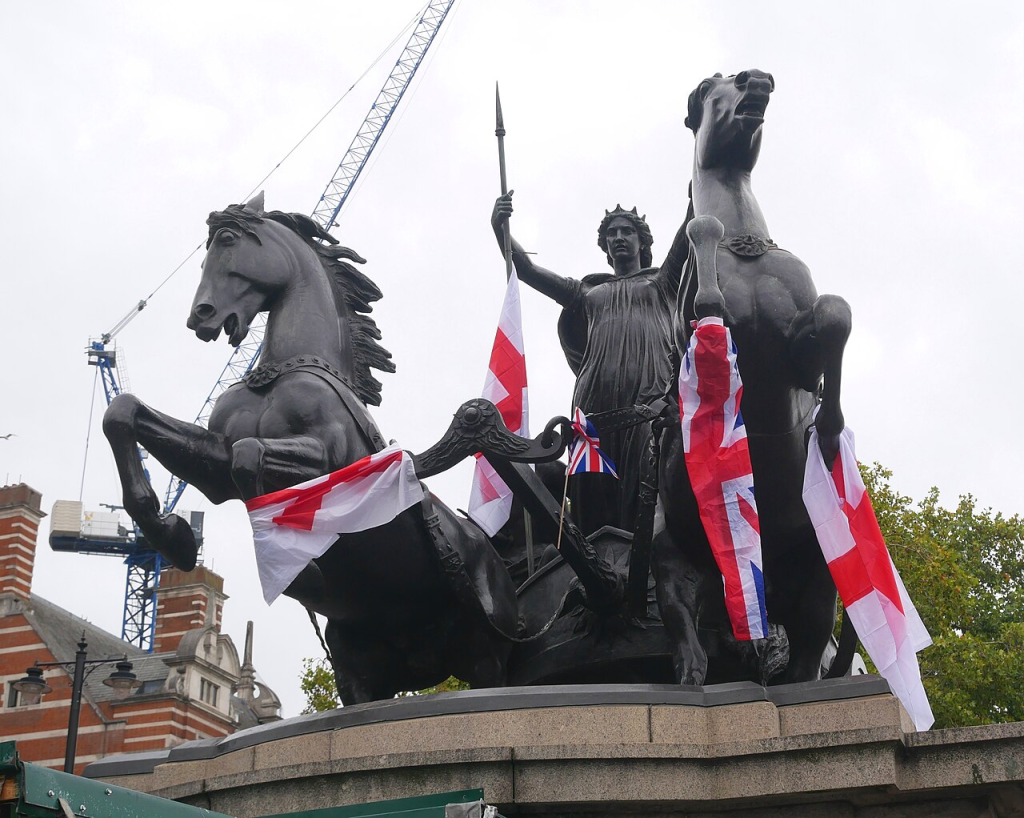
Credit: Doyle of London – Own work, CC BY-SA 4.0, https://commons.wikimedia.org/w/index.php?curid=175116080